

Stick or Twist? The Risks
Stick or Twist? The Risks
The field may not be that green
Our ‘stick or twist’ piece explored the options available to organisations who have legacy frustration. This is a complementary piece that explores some of the evidence around the need to change and the associated risks.
If your operational needs are being constrained by legacy technology you are not alone. In this recent article, some 88% of organisations have similar frustrations. Its fair to say that the vast majority of established organisations have their operational ambitions constrained by legacy systems.
We explored the reasons why legacy systems eventually stall productivity gains here. In this piece we consider the risks associated with replacing legacy systems.

The Grass is Greener…
Logically the technology available in your industry has progressed since you committed to the legacy system that runs your operations. Changing to a new system will address the current constraints. Of course change will be a challenge but that pain will be worth the long term gain.
Operational systems that have been in place for a long time require two aspects to be carefully considered:
- Human: the team of users have adapted to the processes and practices that the legacy technology demands. Bringing people along with the changes that will inevitably affect how they work on a day to day basis is a key challenge.
- Function: it is likely that a number of functional changes have been made to the legacy system. These will be important to how processes operate and their loss may have a significant impact. Replacing them in the new system will be an important success factor.
Incorporating these aspects into a detailed requirements document is critical. We know of one replacement project that, despite the replacement systems reputation in the sector and significant investment, it has, after more than 2 years, failed to adequately address one of the core reasons that motivated the change initiative.
…or Is it…?
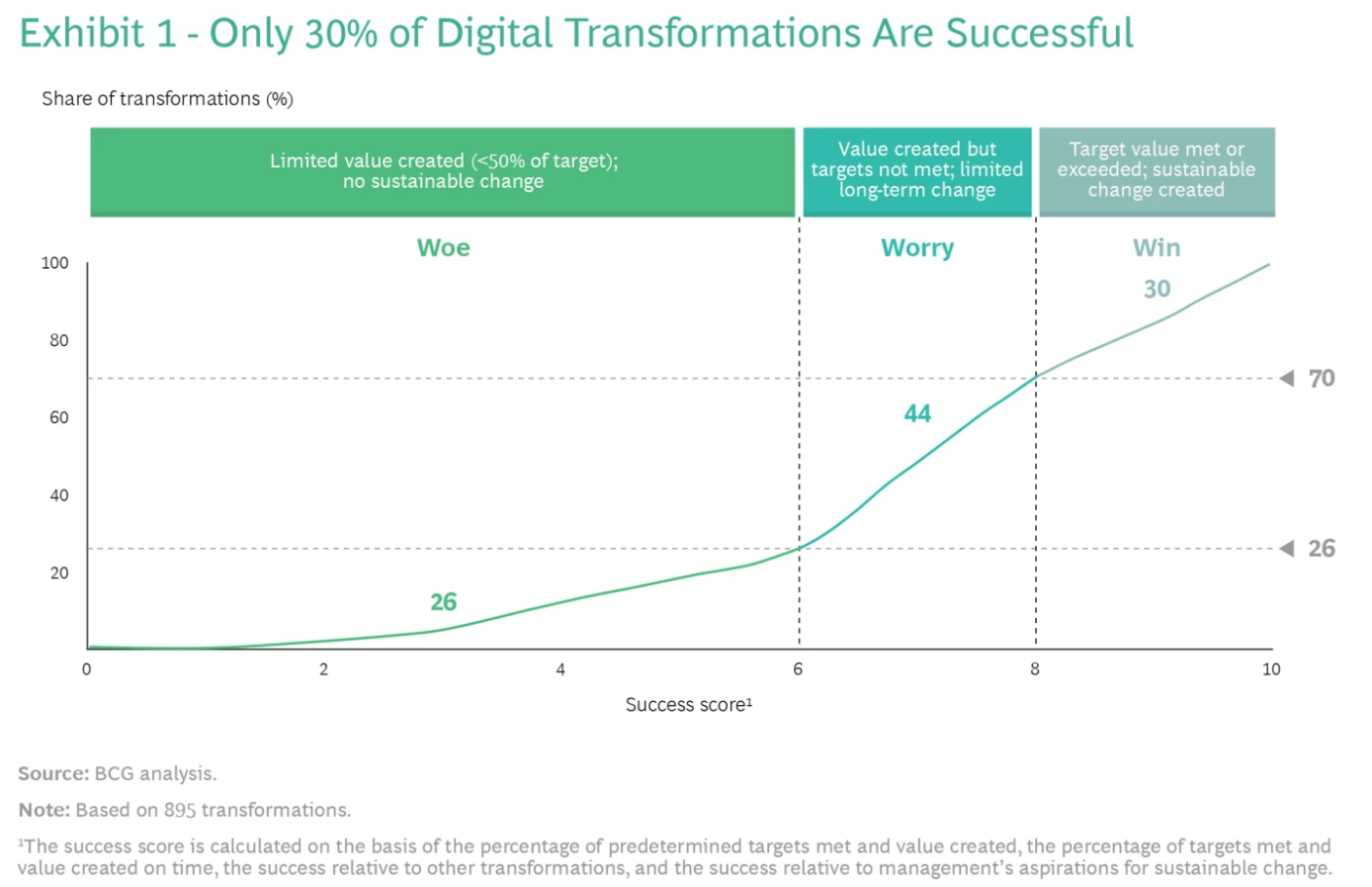
In fact the statistics show that ‘digital transformation’ projects normally fail to deliver the promised value. The research above is replicated from various other reputable sources.
So, it seems fair to conclude that the grass is only greener for 3 out of 10 initiatives. A similar proportion achieved well below the value anticipated.
Reasons why transformations fail
The research points to four primary reasons why initiatives deliver poor outcomes:
- Lack of clear goals and strategy
- Clarity of vision, alignment to business strategy, poor scope
- Insufficient Change Management
- Under-estimating resistance to change, training challenge, poor communications
- Leadership and buy-in
- Sponsorship, leadership through the changes and commitment to success
- Focus on technology, not people and processes
- User experience, cultural impact, additional workload
In our experience the focus on technology is very relevant. If the initiative is defined as ‘changing from legacy to new technology’ this particularly influences the goal / strategy and leadership / team members buy in buy. The new vendor technology people are the primary point of engagement for the internal project team.
Focusing the initiative on people and process might change the definition to ‘improving human and process performance’. This places the emphasis on current processes, user experience and the tasks demands. A vision for improvement can be developed and the technology follows, focusing on how to enable the identified improvements.
Replacement Drag
A contributor to the failure reasons listed above is what we term the replacement drag:

The time and effort required to set up the new system impacts directly, particularly on human factors. In some cases team members can ‘lose the will’ as they see no tangible value for their efforts.
The Upcycle Option
In this piece we explain the upcycle option as an alternative to replacement. In the context of the 4 reasons for transformation failure it could have the following effect:
- Lack of clear goals and strategy
- Focuses on a series of improvement initiatives and so mitigates the need for a grand strategy to be correct
- Insufficient Change Management
- Delivering a series of improvement initiatives focuses the effort, resulting in tangible outcomes quickly. Any adjustments are isolated and quickly addressed
- Leadership and Buy in
- Leading change based on a series of tangible improvements in transformational
- Focus on technology, not people and processes
- User experience and process analysis drive change initiatives rather than technology dominating the initiative
In conclusion, technology dominated transformation initiatives can be seen to be high risk. Upcycling offers a way to mitigate these risks and improve success rates.